
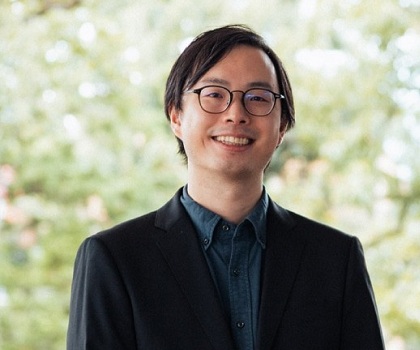
Robert Mok
Main Lab Location:
CiNet (Main bldg.)Specific Research Topic:
Computational Cognitive Neuroscience of Concept Learning and Concept RepresentationOther Affiliations:
Guest Associate Professor, Graduate School of Frontier Biosciences, University of OsakaMailing Address:
1-4 Yamadaoka, Suita City, Osaka 565-0871, JapanEmail:
rob.mok at nict.go.jpHomepage:
https://sites.google.com/site/robmokbrainbob/Conceptual knowledge underlies the ability to understand and learn about our complex world. How do we represent semantic, conceptual knowledge about the world, from day-to-day knowledge such as the function of different tools and knowledge about animal species, to more abstract concepts from cause-and-effect to freedom? How do we learn new concepts (e.g., a new food, kitchen utensil, sport, etc.) and integrate entirely new information into our existing knowledge?
We focus on vision (higher-level vision, learning new visual objects) but very much consider semantic and language influences. We study how the hippocampus (involved in fast learning and episodic memory), and anterior/inferior temporal lobe (represents long-term semantic memory) learns and organizes information when learning new concepts and how they are consolidated into long-term semantic memory. We are also interested in how brain systems change as we age (healthy cognitive aging), especially how aging affects new concept acquisition and semantic representations.
We use behavioural experiments, neuroimaging, and computational modelling (cognitive models & deep neural networks; DNNs).
COMPUTATIONAL FOCUS:
We are using and training DNNs (vision and vision-language models) to uncover computational principles about learning and concept representation. One focus is building more human-like models that are more efficient and robust compared to current AI models. We are building hippocampus-inspired models (e.g., sparse coding) that capture fast and stable human learning, and how this interacts with the slower but high-capacity (dense/distributed) cortical representation.
EXPERIMENTAL FOCUS:
We use 3T and 7T MRI to study how the brain learns and represents concepts. We will study the contribution of hippocampal subfields to concept learning, only possible with high-field 7T MRI. We will also use MEG and stimulation techniques like transcranial ultrasound stimulation to target deep structures like the hippocampus. To relate brain processes to cognitive and computational processes (to DNNs) in our neuroimaging work, we use model-based representational similarity analysis (RSA) and multivariate pattern analysis (MVPA).
If you are interested in any of the ideas mentioned above and would like to chat about possibilities to join as a postdoc or student, please contact me!
Selected Publications:
Luo, X., Mok, R.M., Roads, B.D., & Love, B.C. (2025). Coordinating multiple mental faculties during learning. Scientific Reports, 15, 5319.
Luo, X., Mok, R.M.*, Love, B.C.* (2024). The inevitability and superfluousness of cell types in spatial cognition. eLife. *Co-senior Author.
Mok, R.M. & Love, B.C. (2023). A multilevel account of hippocampal function in spatial and concept learning: Bridging models of behavior and neural assemblies. Science Advances.
Mok, R.M. & Love, B.C. (2022). An abstract neural representation of category membership beyond information coding stimulus or response. Journal of Cognitive Neuroscience, 34(10)1719–1735.
Mok, R.M. & Love, B.C. (2019). A non-spatial account of place and grid cells based on clustering models of concept learning. Nature Communications. 10, 5685.